
How University Living Lab started

Professor Jennifer O’Brien (NTF, PFHEA),
Founder and Director of University Living Lab.
A Geographer by training, and a University of Manchester alumni, Jen founded University Living Lab in 2022 convinced that the 46,000 students at the University of Manchester could be a HUGE lever for change for sustainable development - a hunch that proved to be right! Originally we worked with Manchester’s Oxford Road Corridor and then extended our sustainability framing to the United Nation’s Sustainable Development Goals to broaden the reach of our impact and to be more accessible for our students.
Over the last couple of years:
Jen has been invited to present the University Living Lab (ULL) methodology at a number of prestigious conferences including for Advance HE and the EAUC.
ULL features as a case study of good practice in Rehema et al., 2025’s text ‘Perspectives and Practices of Education for Sustainable Development. A Critical Guide for Higher Education’ (thought to be the textbook for sustainability education).
ULL was presented as one of the original practice guides to achieve ESD by AdvanceHE and by Times Higher Education as part of their Green Skills White Paper informing the International Green Learning and Skills Accelerator which Jen was invited to lead on behalf of the UK.
As ‘Skills’ theme lead for Sustainable Futures, University Living Lab is positioned as a key case study to realise M2035, the University of Manchester’s new strategy.
The University Living Lab has won a number of awards including a University of Manchester Making a Difference Award and a QS Reimagine Education Bronze Regional Award.
The University Living Lab was a ‘golden thread’ in Jen’s National Teaching Fellowship, Principal Fellowship of Advance HE and Fellow of the Royal Society of Arts.
Our University Living Lab is maintained by our students as ULL champions. This role contributes to Stellify, our University of Manchester Leadership award, but moreover ensures that our mission is co-constructed with our student voice. ULL Champions regularly post on our ULL Instagram.
University Living Lab’s Vision
Living Labs affect positive change through experimentation.
Living Labs establish partnerships or programmes which connect academic activities of the institution (such as learning & teaching, and academic research) with non-academic partners. Our University Living Lab is unique because it harnesses the power and capacity of students to affect change through applied research with external organisations as part of their degree learning.
We co-produce student projects with external organisations to help them to meet their sustainable development goals. At the same time our projects enable students to make a difference through their studies whilst developing their skills and enhancing their learning experience. We work under the framework of the United Nations Sustainable Development Goals aiming to work in partnership, leave nobody behind and affect change for a better world, for all, by 2030.
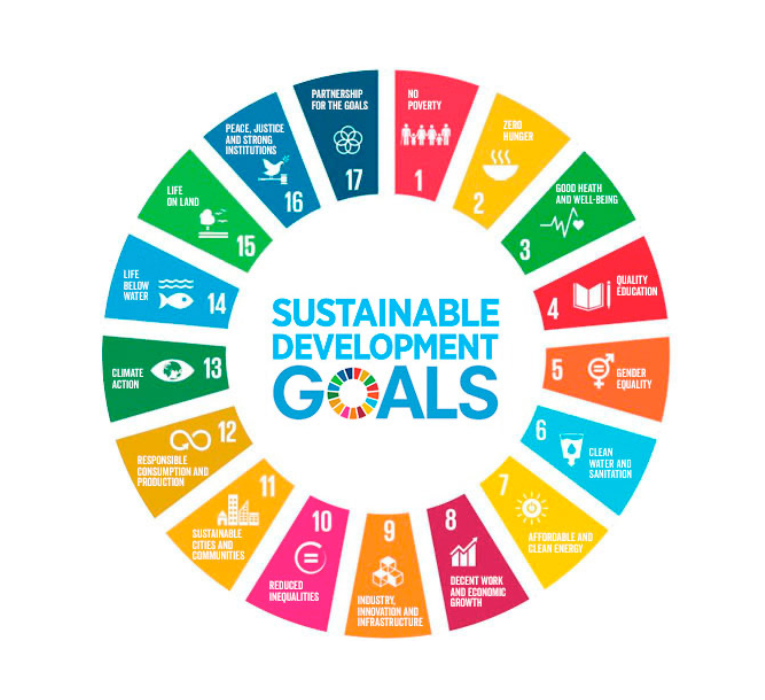
The United Nations Sustainable Development Goals (SDGs) are a blueprint to achieve a better and more sustainable future for all. We have adopted a framework of the 17 SDGs.
Each Project and Report is tagged with its respective SDGs. (This is, of course, open to interpretation and arguably every SDG could be applicable to sustainable development related research).
We use the pedagogy of the SDGs: we work in partnership, we work in an inclusive and accessible way, we believe that interdisciplinary partnership at multi-scale affects change. We also aim to leave nobody behind. For a better and more sustainable future for all, we need to work together to achieve the Goals by 2030.
Why a partnership between students and organisations?
Universities concentrate huge amounts of untapped human resources. Some quick calculations produce rather startling figures. Our institution, the University of Manchester, alone, has 40 000 students, a quarter of whom study subjects related directly to sustainability. According to calculations by Evans et al., (2015) these 10 000 students spend an average of 1500 hours per year studying, of which perhaps half could be directed towards applied research on real world problems with non-academic stakeholders. This would yield 7.5 million hours of research time on sustainability issues- just through students’ core learning. In turn that experience is then accessible to all students.
A similar calculation produces a total of 0.5 million students studying on sustainability related courses in the UK (HESA, 2014), who could offer 375 million hours.

Globally, Goddard (2011) suggests that there will be 262m students in higher education by 2025. Applying the same multipliers results in an annual global research resource for sustainability of 49 billion hours, or 5.6m years.
Even granting considerable margins of error, these figures suggest that the task of engaging university students in real world sustainability challenges is worthwhile- and could have incredible impact.
Explore the site to find out how you can make a difference.

The University Living Lab was established as the first of its kind in 2013. Since then our students have worked with a huge range of partner organisations, including international consultants, governments, health bodies, charities and local businesses. Impacts range from work on urban resilience that was presented to the Rockefeller Foundation in New York, to building business cases for local beekeeping in South Manchester.
“The student reports were really helpful to us as they pointed us to research and potential partners we wouldn't otherwise have known about, and they formed a key part of the plan going forward”
— Craig Thomas, the Old Abbey Taphouse,